JM Week 14

Jan Zita Grover writes about “the burden of scarcity” to explain the negative way in which underrepresentation can affect a group of people.  Particularly focused towards lesbians, Grover notes the tendencies in North America to “downplay the sexual component in the lesbian community and instead emphasize its spiritual or emotional basis” (Grover 186).  Grover also discusses an interactive photography exhibit, Drawing The Line, which displays assorted lesbian sexual practices desires that was poorly received  even by lesbians who Grove claims objected to the photos due to a desire to monitor and censor other viewer’s experience.  Grove notes that the desire to censor this work, for these lesbian women, stems from underrepresentation of lesbians in mainstream media, and particularly sexual representations of women with other women, making the current representations hold a much greater weight than they should.  Grove calls for a wider range of lesbian women to be represented and also a wider range of sexual practices.

I do believe this burden of scarcity does exist in today’s media, particularly for LGBT people.  Oftentimes minority groups are underrepresented or misrepresented in mainstream media, perpetuating stereotypes or simply excluding them from popular culture.  Although there is more representation of LGBT people than ever before in film and to a certain extent, television, the burden of scarcity can still play into misconceptions about LGBT people, especially for those unwilling to seek out other media where LGBT people are more frequently represented.  For example: someone who only watches ABC network television shows may think all gay men are like Modern Family‘s Mitchell and Cameron (effeminate, bourgeois,  and melodramatic).
JM Week 11

It is primarily through the critique of writers of the Independent Gay Forum (IGF), mainly Andrew Sullivan and David Boaz, that Lisa Duggan comes to assert that “freedom”, “equality”, and democratic politics through this neoliberal mindset are deeply perverted.  Sullivan’s exclusive targeting of the masculine gay limits the “equality” pushed for in his writings and also reinforces typical misogyny which exists throughout the heteronormative order.  Sullivan also suggests that gay people must simply ask to exist in a privatized space, where the only political victories are marriage equality and the right to serve in the military.  As Duggan notes, “…we have been administered a kind of political sedative — we get marriage and the military, then we go home and cook dinner, forever” (Duggan 62).  David Boaz, another neoliberal writer for the IGF, sees the family only as a gendered institution that is used for privatizing social costs, and again insists only that gays be included in this system.

In “Boystown”, Blair demonstrates the power of social media in reproducing racism.  Under the guise of protecting the neighborhood from crime, Facebook pages were used as a channel of hate speech and racism, distanced from the “real world” and through uncensored white privilege were able to control a racist narrative about the city in which they lived.  These social media pages “allowed residents to public produce and engage with bigoted attitudes, ideologies, and discourses through photographs, videos, and concurrent threaded comments” (Blair 298) and therefore legitimized degrading and criminalizing people of color.

Through the colonialist ideology of the “native”, Third World gay men are essentially positioned as a commodity, or an object to be consumed.  This of course is reinforced by capitalism and the notion of “gay” capital in which travel is one of the primary sources of revenue.  In this space in which Third World gay men are fetishized by white gay men on vacation, “gay capital becomes an active participant in the same processes of nativization and recolonization that heterosexual tourism helped to inaugurate” (Alexander 79).


Citations:

Alexander, M. Jacqui. “Imperial Desire / Sexual Utopias: White Gay Capital and Transnational Tourism”. Pedagogies of Crossing, edited by M. Jacqui Alexander, Duke University Press: 2005, pp. 67-88.

Blair, Zachary.  “Boystown”. No Tea, No Shade, edited by E. Patrick Johnson, Duke University Press: 2016, pp. 287-303

Duggan, Lisa. “Equality, Inc.”. The Twilight of Equality?, edited by Lisa Duggan, Beacon Press: 2004, pp. 43-66.

JM Week 10

With respect to recent anti-discrimination law reform for trans people, Dean Spade identifies several reasons why anti-discrimination laws are ineffective in actually improving the quality of trans lives.  Working off of Alan Freeman’s critique of the perpetrator perspective, Spade notes how the imposed view of discrimination as something which occurs between a perpetrator and a victim completely ignores larger structures of discrimination which have existed in the past and will continue to exist without more powerful reform.  Spade argues that anti-discrimination laws cannot address disparities in life conditions “that we know stem from and reflect long term patterns of exclusion and exploitation cannot be understood as ‘violations’ under the discrimination principle, and thus remedies cannot be won” (Spade 43).

With regard to hate crime laws, Spades primary critique is that ultimately these laws do more to reinforce and expand the prison system which so often falsely holds and abuses trans people.  Simply put: “Criminal punishment cannot be the method we use to stop transphobia when the criminal punishment system is the most significant perpetrator of violence against trans people” (Spade 47).  Spade notes, “Could [the veterans of Stonewall] have imagined that the police would be claimed protectors of queer and trans people against violence, while imprisonment and police brutality were skyrocketing?” (Spade 46).  Prison abolitionists argue that prison reform, rather than addressing unfairness and injustice in prisons, more often lead to prison expansion than anything else.


Citations:

Spade, Dean.  Normal Life: Administrative Violence, Critical Trans Politics, and the Limits of Law.  Durham & London: Duke University Press. 2015.

JM Week 7

The antisocial thesis in queer theory is the idea that being queer and queer people themselves are fundamentally incompatible with the social order currently in place, the most apparent example of this being gay sex which unlike heterosexual sex doesn’t serve a reproductive purpose and thereby subverts the social notion of family.  This antisocial thesis is often thought about in conjunction with negativity and follows up on Bersani’s definition of sex as “anticommunitarian, self-shattering, and anti-identitarian” (PLMA 823). One particularly interesting aspect of the antisocial thesis in queer theory is Bersani’s discussion of the media and “its capacity to manufacture subjectivity itself” (203).  Effectively emphasizing the social separation of gay people from the “general public” Bersani notes “the family identity produced on American television is much more likely to include your dog than your homosexual brother or sister” (203).  Another premise which stands out is the connection between queer people and antisocial politics such as anarchy and its parallel in punk music – begging the question: do all queers share the same or at the very least, similar negative and antisocial politics?

Rodríguez’s discussion of “politically incorrect erotic desires” (342) adds some fresh perspective to the antisocial thesis.  These desires are related to the antisocial perhaps in their subversion of power or gender structures also in their multiplicity and limitless possibility.  Rodríguez discusses fantasies to include those not included in Bersani and Edelman’s writings, almost everyone besides gay white men.  Whereas Bersani and Edelman both focus on sexual acts, specifically anal sex between gay men which Edelman links with the death drive, Rodríguez discusses fantasies on a spectrum which brings race, gender, and power into the sphere of erotic desires.


Citations:

Leo Bersani, Is the Rectum a Grave?

PMLA, The Antisocial Thesis in Queer Theory

Juana María Rodríguez, Queer Sociality and Other Sexual Fantasies


JM Week 6

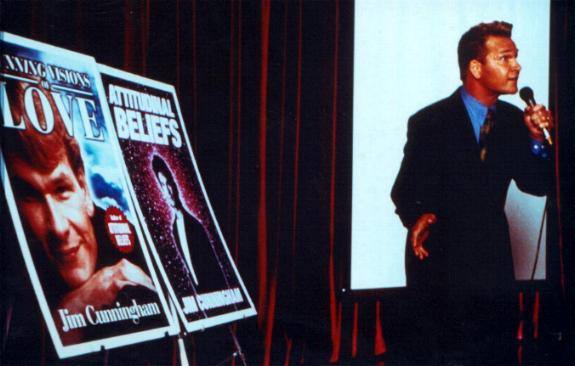
The image above is of Jim Cunningham, a fictional highly conservative motivational speaker in the film Donnie Darko.  His ideology separates the world simply into love and fear, labelling premarital sex and presumably any other type of sex besides the “essential” married heterosexual couple’s sex as a product of fear (Rubin).  The fact that he speaks at middle and high schools displays the administration’s fear of “sexually deviant” students corrupting an otherwise pure institution.

Adding asexuality as a consideration into this ideology, I would think Cunningham’s response to an asexual student would be something similar to Dr. House’s (Przybylo).  It certainly does complicate the matter of all sex outside of marriage being a product of fear.  If there is no desire for sex, there is no risk of sexual deviancy.  However, the very absence of sexual desire may be seen as deviancy in the eyes of a character such as Cunningham.

Citations:

Rubin, Afterward to Thinking Sex

Pryzybylo, Introducing asexuality, unthinking sex

Image from: http://www.patrickswayze.net/Movies/darko.htm


JM Week 5

The last stanza of Anzaldúa’s poem “To Live in the Borderlands” is instructional in nature and contains two distinct suggestions.  This advice is pointed towards those living in “the Borderlands” which seems to represent  a non-physical space of both racial and gender difference.  Therefore “sin fronteras” suggests that those who do not have a single racial identity or who do not fall into the gender binary must accept all others who are in a similar crossroad of race, gender or both.  The last line of the poem “be a crossroads” follows up on the suggestion of living “sin fronteras”, and extends the invitation to not only accept all others who do not fall into distinct categories of race or gender, but also to act as a crossroads, a point of connection and solidarity for these people.

The transitions between English and Spanish in the poem function as the voice of the author as a bilingual person who most likely switches between the two languages in their everyday life and also as a voice of Spanish speaking person insulting them for being mixed race.  Particularly the lines “ni gabacha, eras mestiza, mulata // … // you’re a burra, buey, scapegoat” show this rejection and name calling the author has endured from other Spanish speaking people in their own terms.    The effect of this is to place the reader more in the author’s position, and to make the insults from Spanish speaking people more real and nuanced rather than substituting in semi-equivalent English insults.

JM Week 4

Allison Reed’s essay “The Whiter the Bread” is an impressively effective piece of writing in which the author substantiates her claims not only with examples from pop culture and everyday lived experiences but also with poignant critiques of other queer theorists who fail to connect race and racism or simply fail to acknowledge race at all.  Reed argues that “fetishization of blackness” is used for an extreme generalization of trauma, claimed by all queer people “articulating embodiment in post-racial terms” (57).  By ignoring the distinct identities of non-white queer people and gathering all trauma under a single “queer” umbrella, the particular issues of race racism become hidden and are left critically unacknowledged.  In this way, the trauma is dealt with in a way that acts as if race no longer exists, as if this is an actual reality of any country.  This “post-racial” mode of thought erases not only the history which underlies the current political climate but also the non-white voices to whom the trauma truly belongs.

Reed also argues that queer white people have a tendency to separate themselves from whiteness by identifying as queer – “other” and therefore claim the trauma of all queer people as their own.  While this sharing of trauma and collective thought is not problematic in itself, it is important that white queers do not whitewash this trauma and fail to recognize how for example the trauma a Latinx queer experiences after the Pulse Nightclub Massacre is different than the trauma a white queer experiences.  Reed argues that black bodies are often portrayed in a spectacular manner for the benefit of white queer politics citing “Orange is the New Black” as one example of how Hollywood displays black trauma and vulnerability as in the past and not ongoing (51).  This hypervisibility of black bodies serves to benefit what Reed describes as “a white queer politics of injury” (57).  In this schema, white queer politics gains traction through highlighting the trauma of black queers without addressing racism at all or recognizing the distinct experience of black queers as something other than simply an object upon which trauma falls.  Reed’s following statement succinctly and effectively describes the issue: “When queer theory sterilizes sites of injury by displacing material realities of trauma from their representation, lived experiences morph into post-racialize metaphors that preempt possibilities for justice” (59).

Citation:  Reed, Allison. “The Whiter the Bread, the Quicker You’re Dead”.   No Tea, No Shade: New Writings in Black Queer Studies. Patrick Johnson. 49-64. Print.


JM Week 3

Queer Theory is a post-modernist approach to analysis that attempts to deconstruct existing preconceptions of sexuality and gender as they relate to larger structures such as social interactions, political institutions, and power dynamics.  It also helps to redefine expressions of sexuality and gender outside of the typical binaries, i.e. Homo/Heterosexual, Male/Female.

I think Queer Theory could be a useful topic of study for other Audio / Music Engineering majors simply to bring awareness of or to create a general context by which to understand and relate to people whose gender expression and/or sexuality falls outside of the typical binaries.  For those working directly with artists, e.g. recording/mixing engineers or producers, it is absolutely essential to be able to relate to and communicate effectively with the artist you are helping create art with.  In a traditionally cisgendered male dominated field, it is essential that engineers understand and help to facilitate and solidify the message of the artist.  With queer artists starting to become more and more visible in mainstream media, studios need to function not only as places of business but also safe spaces for artists of all gender identities  and sexual orientations.

Cathy Cohen as a queer woman of color has a great deal of insight into the necessity for the intersectionality of queer politics.  She argues that marriage and homosexuality plus the ideology of white supremacy were reconfigured to justify the exploitation and regulation of black bodies.  One such example of this reconfiguration is evident in the illegality of mixed race marriages which remained in place from colonial times until 1967 with the notion of keeping the white race “pure” at the center of its enforcement (454).  In this way black Americans became even more “other” to whites and without the legal intervention that eventually allowed mixed race marriage would remain even more segregated.  This argument ties into Cohen’s discussion of coalition politics in that it presents a parallel to the illegality and suppression of gay marriage with a similar argument involving purity, thereby tying two marginalized groups together and relating their struggles rather than feeding into the divisive dichotomy of straights vs. queers.  Coalition politics is difficult in this way as it necessitates cooperation and a shared sense of marginalization in order to properly draw all groups into the “fight”.  In the case of the AIDS ACT UP coalition, the universality of the issue and the unified resistance against the government’s and biomedical industries’ response to the epidemic was the motivator for all different groups of people to join in.  However without such a wide-scale crisis it is harder for marginalized people of all races, sexual orientations, and classes to step outside of their usual spaces and social spheres.

Citation: Cohen, Cathy J. “Punks, Bulldaggers and Welfare Queens: The Radical Potential of Queer Politics?”, GLQ, vol. 3,  1997, pp. 437-465.

JM Week 2 Readings

Hollibaugh’s claim that gay liberation movement turned into a “tame civil rights challenge” is sustained primarily by the fact that the focus of the movement became primarily concerned with gay legal rights, as compared to the previous struggles “for sexual, economic and social justice”.  In this way, the movement has been primarily confined to courts and chooses only “gender-appropriate” representatives to fight its battles and show everyone else that “we are just like them”.  While the author does acknowledge the success in legal battles, it stresses the lack of scope, difference, and voice for those who are often left out of the picture when “gay rights” are spoken about.

Wilchins states that the distinction between sexual orientation and gender in a way prevents awareness within and outside the LGBT community.  One example she provides is when speaking to a group of gay men, they are all reluctant to admit they are bottoms – often seen as feminine role in gay sex.  Even in her experiences with “otherwise sophisticated and aware” men, they still seem to have issues with gender.  Because the issues of sexual orientation and gender are so separated in America, the latter is often forgotten about – or is at least perceived as more taboo.  In my own experiences, I find discussing my bisexuality a much more comfortable act than expressing femininity publicly, whether that be in the way I act or dress – it seems to create a greater sense of vulnerability.  This is perhaps due to the increased attention on the new legal rights and successes gay and trans people have had in this country, but the reluctance to include gender as a topic of discussion on mainstream news outlets.  As now it seems the two are almost entirely separated issues, the widespread issues with gender really need to find themselves into the public sphere of discourse, not only in terms of the current binary i.e. it is ok for boys to like “girly” things but also in a post-modernist way – deconstructing the current notions of gender as something rigid and un-changing.